Identifying the Issue
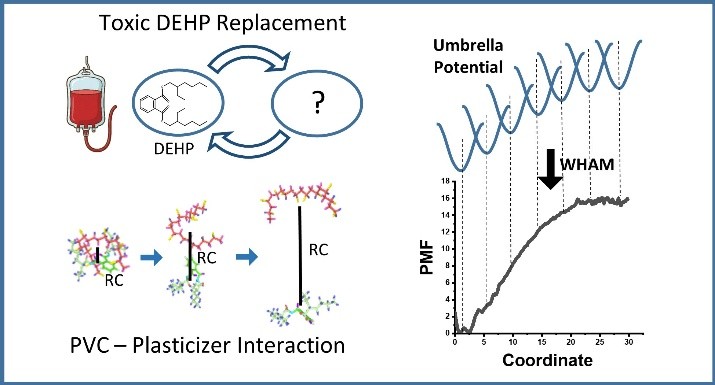
Polyvinyl chloride (PVC) requires plasticizers to achieve flexibility for applications such as medical devices and packaging. However, commonly used plasticizers like DEHP pose toxicity risks due to leaching. Selecting safe and compatible alternatives remains challenging because the molecular-level interactions governing performance are not fully understood.
Objective of the Research
To systematically investigate and quantify the molecular-level interactions between polyvinyl chloride (PVC) and a range of plasticizers through atomistic simulations, with the goal of identifying safer, sustainable, and high-performance alternatives to conventional toxic plasticizers.
Who should read this?
This work is intended for faculty members, research scholars, and students in the fields of computational chemistry, materials science, polymer science, and chemical engineering. It is also relevant to researchers and industry professionals involved in polymers, plastics, leachables and extractables studies, and advanced materials development.
Solution
This study employs atomistic molecular dynamics (MD) simulations combined with potential of mean force (PMF) calculations to analyze interactions between PVC chains and 14 different plasticizers across multiple chemical families. The research develops a validated model that correlates PMF profiles with intermolecular interaction forces, primarily governed by van der Waals and electrostatic contributions. By systematically evaluating PVC chains of varying lengths (6–20 repeat units) and averaging results over 30 independent simulations, the study provides robust insights into how plasticizer molecular structure influences binding affinity and compatibility. The findings rank plasticizers based on interaction strength and identify promising alternatives such as TOTM, BTHC, ATHC, and DEHT. This computational framework enables predictive screening of plasticizers, reducing reliance on experimental trial-and-error while supporting the design of safer and more efficient PVC materials.
Key Features and Benefits
- Enhances understanding of structure–performance relationships in PVC–plasticizer systems
- Develops a robust full-atomistic molecular dynamics (FAMD) simulation framework for analyzing polymer–plasticizer interactions at the molecular level
- Identifies safer and more sustainable alternatives to toxic conventional plasticizers such as DEHP
- Provides insights into how plasticizer structural features influence interactions with PVC and affect material performance
- Supports the rational design of novel high-performance plasticizers with the potential to replace DEHP
Impact
- Facilitates the design and development of novel, safer plasticizers with the potential to replace conventional toxic plasticizers such as DEHP
- Supports the identification of environmentally friendly and biocompatible plasticizer alternatives, contributing to improved human health and safety
- Provides a computational screening framework that significantly reduces the time, cost, and experimental effort required for evaluating polymer–plasticizer compatibility and performance
- Advances sustainable material innovation in the polymer and plastics industries by enabling the development of high-performance, low-toxicity materials
- Generates molecular-level insights into PVC–plasticizer interactions, aiding researchers and industries in optimizing material properties for diverse industrial applications
Team
Sai Athmeeya G. Shet – https://in.linkedin.com/in/saiathmeeya
(Department of Chemistry, Sri Sathya Sai Institute of Higher Learning)
V. N. Ravi Kishore Vutukuri – https://in.linkedin.com/in/v-n-ravi-kishore-v-5996146
(Department of Chemistry, Sri Sathya Sai Institute of Higher Learning)
Collaborators:
Jan-Michael Y. Carrillo – https://www.linkedin.com/in/janmikel
(Center for Nanophase Materials Sciences, Oak Ridge National Laboratory, United States)
Jacek Jakowski – https://www.linkedin.com/in/jacek-jakowski-23572712
(Computational Sciences and Engineering Division, Oak Ridge National Laboratory, United States)
S. S. R. Kumar Challa – https://www.linkedin.com/in/kumar-challa-4a30284
(Xheme Inc., Massachusetts, United States)
Title of paper: “Investigating PVC polymer–plasticizer interactions with atomistic MD simulations and potential of mean force calculations”
Read Paper Here: https://doi.org/10.1039/D5CP04798F